


With schools in remote learning, many parents are searching for activities that actually keep their little ones engaged and not just filling time. The good news? You don’t need a classroom full of resources or a teaching degree. The Early Years Foundation Stage (EYFS) framework that we use here at The Wonder Years ECC is built around something children already do naturally: play, explore, and discover.
In this guide, we’re sharing 20 EYFS-aligned home learning activities that any parent can do with children aged 6 months to 4 years, using everyday items you already have at home. Each activity is linked to one of the seven EYFS learning areas, so you can feel confident that your child is developing exactly the skills they need, even away from nursery.
From Our EYFS Team at Wonder Years ECC:
The most important thing during remote learning is not structured “lessons”. It’s connection, conversation, and play. Every activity in this list supports your child’s development exactly where they are right now.
What Is EYFS and Why Does It Work at Home?
The Early Years Foundation Stage is the British Government’s framework for children’s learning and development from birth to age five. At Wonder Years ECC, it underpins everything we do, from how we arrange our classrooms to the songs we sing during play.
The framework covers seven areas of learning:
- Communication & Language — Talking, listening, and understanding
- Physical Development — Gross and fine motor skills
- Personal, Social & Emotional Development — Confidence, self-regulation, relationships
- Literacy — Mark-making, stories, early reading
- Mathematics — Numbers, shapes, patterns
- Understanding the World — Science, nature, culture, technology
- Expressive Arts & Design — Creativity, music, role play
The beauty of EYFS is that none of these require specialised equipment. Your kitchen, garden, and living room are already a learning environment. You just need to know where to look.
Safety Reminder: Always stay with your child and supervise them closely during every activity. Never leave your child alone while they are playing, especially with sensory materials, physical activities, or any objects that could pose a risk.
The 20 Activities
Communication & Language Activities
Activity 1: The Treasure Basket | Ages: 6–18 months
Fill a small basket or box with 8–10 safe household objects of different textures — a wooden spoon, a soft teddy bear, a fabric swatch, a rubber duck, a silicone bowl, a small plastic cup. Let your baby explore freely, handling each object. Narrate as they touch: ‘That’s soft, isn’t it? This one feels bumpy.
Activity 2: Story Retelling with Toys | Ages: 2–4 years
After reading a favourite book, put it away and place a few toy characters or objects from the story on the floor. Ask your child to retell the story using the toys. Don’t correct — listen, prompt with “And then what happened?” and let their imagination lead.
Activity 3: “I Spy” With a Twist | Ages: 2–4 years
Play a descriptive version of I Spy: instead of letters, describe a property. “I spy something that is cold… and hard… and we use it when we’re thirsty.” This builds vocabulary and descriptive language far more than the letter version.
Activity 4: Puppet Show Time | Ages: 18 months–4 years
Grab your child’s favourite toys — a teddy bear, a doll, or a soft animal — and give them a voice. Children 18 months+ love watching you do voices and little conversations between toys; by age 3, most will take over and create their own little story-worlds. Leave the toys out together in a basket for free play discovery.
Physical Development Activities
Activity 5: Sensory Tray Play | Ages: 6 months–3 years
Fill a shallow baking tray or container with one material at a time: dry rice, sand, shredded paper, cooked cold pasta, or water with food colouring. Add cups and spoons for scooping and pouring. This is messy — put a towel underneath — and absolutely wonderful for small hands.
Activity 6: Obstacle Course in the Living Room | Ages: 18 months–4 years
Place sofa cushions flat on the floor for children to step and jump between, tape a strip of masking tape as a balance “beam”, and arrange chairs to crawl under. Gross motor play at this age is not optional — it directly supports brain development and coordination. Aim for at least 30 minutes of active movement daily.
Activity 7: Playdough from Your Kitchen | Ages: 18 months–4 years
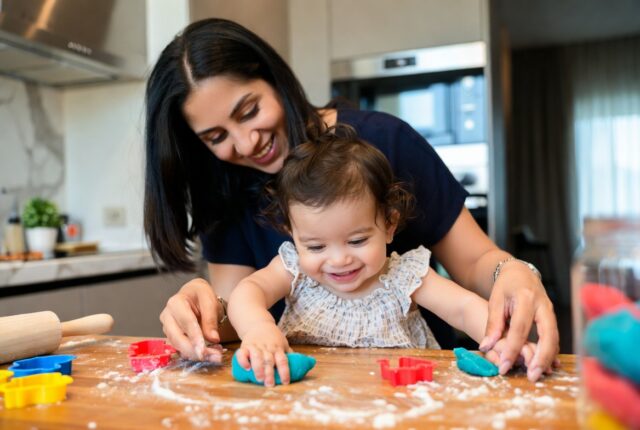
Mix 2 cups flour, 1 cup salt, 2 tsp cream of tartar, 2 tbsp oil, and 1.5 cups boiling water with food colouring. Knead until smooth. Provide rolling pins, cookie cutters, and safe plastic tools. Playdough builds finger strength essential for future writing.
Activity 8: Dancing to the Beat | Ages: 6 months–4 years
Put on music with a clear beat — anything from nursery rhymes to world music — and move together. For babies, gentle bouncing and swaying. For toddlers, try freeze dance (stop when the music pauses). For 3–4 year olds, teach simple sequences: clap-clap-jump.
Personal, Social & Emotional Development
Activity 9: Feelings Faces Mirror Game | Ages: 18 months–4 years
Sit together with a small mirror. Pull a face — happy, sad, surprised, worried — and name it clearly. Ask your child to copy it, then swap roles. Talk about when we feel this way: “When do you feel surprised? What about worried?” Emotional literacy is one of the most powerful gifts you can give a young child.
Activity 10: Special Helper of the Day | Ages: 2–4 years
Give your child a simple, real job each morning: feeding the pet, watering a plant, setting the table (even imperfectly), sorting socks. Real responsibility — not pretend — builds genuine self-confidence and a sense of contribution to the family.
Literacy Activities
Activity 11: Mark-Making Station | Ages: 18 months–4 years
Set up a small tray with chalk, crayons, large paper, and even a tray of flour or salt to draw patterns in. Do not focus on letters yet. The goal is building the hand muscles and the love of making marks. Ask: “What did you make? Tell me about it.” Do not say “I can’t tell what that is.”
Activity 12: Environmental Print Hunt | Ages: 2–4 years
Find letters and words on cereal boxes, road signs, labels, and packaging. Point and name them excitedly. Children recognise their own name and familiar logos long before formal reading — this builds on that natural instinct.
Activity 13: Bedtime Story Question Game | Ages: 2–4 years
Before reading, look at the front cover together and ask: “What do you think this story is about?” During reading, pause at key moments: “What do you think will happen next?” Prediction and comprehension are more important at this age than decoding words.
Mathematics Activities
Activity 14: Kitchen Counting & Measuring | Ages: 2–4 years
Cooking together is pure mathematics. Count the eggs as they go in. Pour water to a marked line. Compare big and small bowls. Sort pasta shapes. “We need 3 spoons of sugar — let’s count together.” Keep it conversational and joyful, not quiz-like.
Activity 15: Shape Hunt Around the Home | Ages: 2–4 years
Challenge your child to find as many circles as possible in one room. Then squares, then triangles. For older children, add 3D shapes: “Find something that is a cylinder… a sphere…” Take photos on your phone and make a shape book together.
Activity 16: Pattern Blocks with Household Items | Ages: 18 months–4 years
Use buttons, coins, dried pasta, or building blocks to make a repeating pattern: red-blue-red-blue. Lay it out and ask your child to continue it. Patterns are the foundation of algebraic thinking and deeply satisfying to young minds.
Understanding the World
Activity 17: Nature Journal | Ages: 2–4 years
Check on a houseplant each day. Draw what you see. Questions to ask: “What changed since yesterday? Why do you think that happened?”
Activity 18: Family Photo Tour | Ages: 18 months–4 years
Look through family photos together and talk about the people, places, and events in them. “This is Grandma when she was little. This is where we went on holiday.” A child’s sense of identity — who they are and where they belong — is a core EYFS goal.
Expressive Arts & Design
Activity 19: Loose Parts Art | Ages: 18 months–4 years
Gather a collection of ‘loose parts’ — bottle caps, fabric scraps, leaves, ribbon, cardboard tubes, sticks, stones — and put them in a tray with some glue sticks and paper. Step back. Let your child create freely without a template or expected outcome. Process over product.
Activity 20: Build a Den | Ages: 18 months–4 years

Drape a blanket over chairs to create a cosy, private space. Add a torch, some soft toys, and a few books. Dens trigger imaginative play that can last for hours. Children use dens to process emotions, rehearse social scenarios, and feel safe. It may be the most powerful activity on this list.
Tips for Making Home Learning Work
A few guiding principles from our EYFS team that will make all the difference:
- Follow their lead. If they’re obsessed with water play for a week, lean in. Sustained interest drives deeper learning than moving on to the next activity.
- Talk constantly. The single biggest predictor of language development is the number of words a child hears — and specifically, the number of back-and-forth conversational turns. Narrate, question, respond.
- Let them fail safely. When your child can’t get the shape sorter piece in, resist fixing it immediately. Sit with them in the difficulty. That’s where resilience is built.
- Rotate toys every few days. Children engage more deeply with fewer things. A cluttered play space leads to scattered, shallow play.
A Note on In-Person Nursery Care
We know that home learning guides and free online resources can feel like good options during remote learning and some of them genuinely are. But we also want to be honest with you: there are things that nursery provides that simply cannot be replicated on a screen or by a parent alone. Peer socialisation, the rituals of group life, the independence of being in a different caring relationship. These are core developmental experiences for under-5s. If you are considering what is right for your child right now, we’d love to talk with you about what Wonder Years ECC offers, and how our two campuses are supporting families.
How Wonder Years ECC Supports Families at Home
At The Wonder Years Early Childhood Centre, our relationship with families doesn’t stop at the nursery gate. Our EYFS-qualified team at both our Dubai Sports City and Remraam campuses is available to support parents with:
- Regular updates and home-learning ideas via our parent communication channels
- One-to-one guidance from your child’s key person on activities suited to their specific stage
- Sharing learning documentation so you can see exactly what concepts we are currently exploring with your child
- Transition support for children joining or returning to nursery after a remote period
A Simple Daily Home Learning Routine
Structure matters more than duration. Here is a simple, flexible framework you can adapt:
| Time | Activity Suggestion |
| Morning | Physical movement — obstacle course, dancing, outdoor time if possible |
| Mid-Morning | Creative / sensory — playdough, art, loose parts, sensory tray |
| Before Lunch | Literacy time — shared reading, story retelling, mark-making |
| After Lunch | Quiet / rest — den play, puzzles, looking at books independently |
| Afternoon | Mathematics / world exploration — cooking together, nature journal, shape hunt |
| Early Evening | Wind-down routine — puppets, feelings conversation, bedtime story |
Ready to See Wonder Years ECC for Yourself?
We would love to welcome your family to either of our campuses. Whether you are a current parent looking for more support during remote learning, or a new family considering enrolment for the year ahead, our doors are open.
Call or WhatsApp our Dubai Sports City campus on 0581054306, or our Remraam campus on 0581054307. You can also visit wonderyearsecc.com to find out more about our EYFS approach, facilities, and enrolment process.